


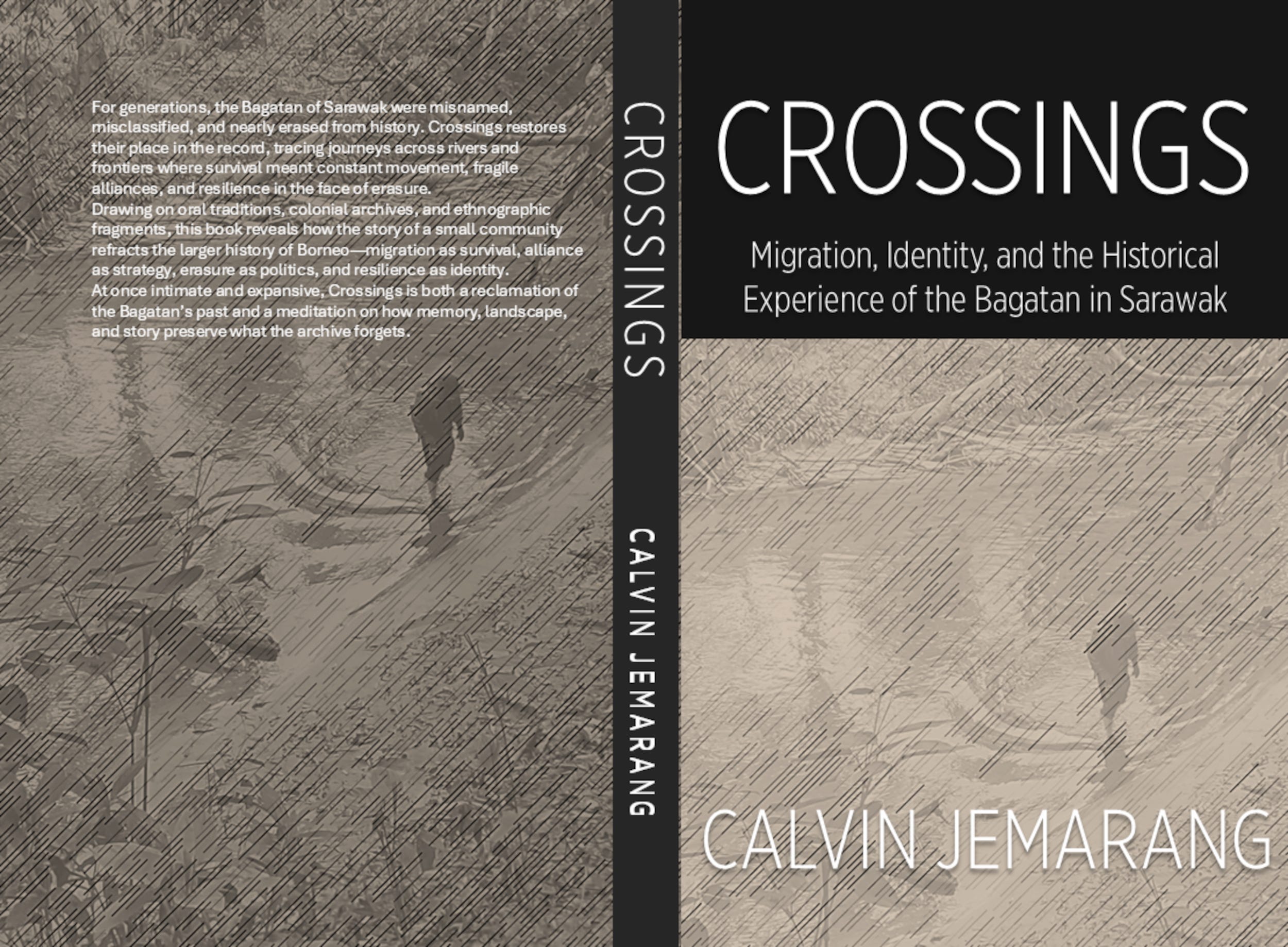
I have yet to cross the finish line. But I can see the crowd at least. The path has been long, winding through archives and oral traditions, across rivers and into conversations that stretch back generations. Each step has carried me further into the layered histories of Sarawak, where memory and silence contend with one another, and where the voices of the Bagatan wait to be heard again.
This book—my forthcoming Crossings—is not simply a revision of an earlier attempt. It is a return, a reimagining, and a reclamation. My first book was written quickly, with urgency and a narrow audience in mind. It carried the weight of immediacy, but also the limitations of haste. This new work is different. It is slower, more deliberate, and written for a wider public: for anyone who cares about the histories that slip through the cracks, the voices that risk being silenced, and the communities whose names have too often been misclassified or erased.
For generations, the Bagatan of Sarawak were misnamed, misclassified, and nearly erased from history. Crossings restores their place in the record—tracing journeys across rivers and frontiers where survival meant constant movement, fragile alliances, and resilience in the face of erasure.
Drawing on oral traditions, colonial archives, and ethnographic fragments, the book reveals how the story of one small community refracts the larger history of Borneo:
• migration as survival
• alliance as strategy
• erasure as politics
• resilience as identity
Yet Crossings is not only about the Bagatan. It is also about the larger question of how memory, landscape, and story preserve what the archive forgets. It asks how fragile threads—songs, names, places—hold history together when official records fall silent. It reflects on the resilience of communities who refuse to disappear, even when the world insists on their invisibility.
This project is, above all, a labor of love for the minorities of Sarawak. Each page feels like a small act of restoration—an attempt to honor memory where silence has reigned too long. The work is painstaking, sometimes exhausting, but deeply rewarding. To write Crossings is to walk alongside the Bagatan, to listen carefully to what remains, and to insist that their story belongs not at the margins but at the center of Borneo’s history.
I am not at the end yet. The manuscript is still taking shape, and there are many crossings left to make. But the contours are clear, and the finish line is in sight. As 2026 approaches, I look forward to sharing more of this journey—its challenges, its discoveries, and its quiet triumphs—with all of you.