

The Document That Should Not Exist
How the Bagatan of Pejarai wrote an impossible history, blocked a government project, and kept their dead at the bottom of a river

In 2023, an old man stood up in front of a minister and claimed a set of submerged burial poles without knowing the name of the river they were in. He sat back down. What happened next took a lawyer, a handwritten sign, and a document with impossible dates.
This article is for paid subscribers. Thank you for making this work possible.
In 2023, at Rumah Ado Bilong, an old man stood up in front of a minister.
He was small, perhaps five and a half feet, but he rose with the unhurried authority of someone who had never needed height to be heard. His name was Tr. Samun ak Anyot, and he had one thing to say to Dato Sri John Sikie Tayai and the officials assembled around him: the klirieng belong to Tatau. Not to the government. Not to a conservation facility somewhere downstream. To Tatau.
Someone asked him which Tatau. He didn’t know the name.
He sat back down.
I watched this from across the room and understood, in the way you understand things that take years to fully articulate, that I had just witnessed something precise and ancient. Tr. Samun could not name the place. But he knew, with a certainty that no document had given him and no document could take away, that the claim was his to make. The klirieng — carved burial poles, now lying at the bottom of the Pejarai River — were not artifacts waiting to be rescued. They were his people’s dead, and they were exactly where they belonged.
What I did not know then was that somewhere in Bintulu, the sons of Tr. Samun were writing a history. And that history would place their father’s ancestors in 1771, more than a century and a half before those ancestors were born.
The klirieng had been at the bottom of the Pejarai for four or five decades by the time anyone in government thought to retrieve them. Five poles, toppled into the river near the mouth of the Mesken River — recorded as Maskin on government maps, a small cartographic erasure that tells you something about how places get named when the people who live there are not in the room. The poles were massive, each stretching more than six meters, carved in the tradition of the Tatau basin. One was discovered on the riverbank in October 2021, partially surfaced, its geometric carvings worn almost smooth by decades of water and sun. Researchers who examined it connected the site by oral history to Orang Kaya Sungan, a Punan tengelan whose authority over the Tatau basin reached back to the seventeenth century. These were not anonymous objects. They marked the dead of a specific lineage, in a specific place, for reasons that the river had been slowly obscuring ever since.
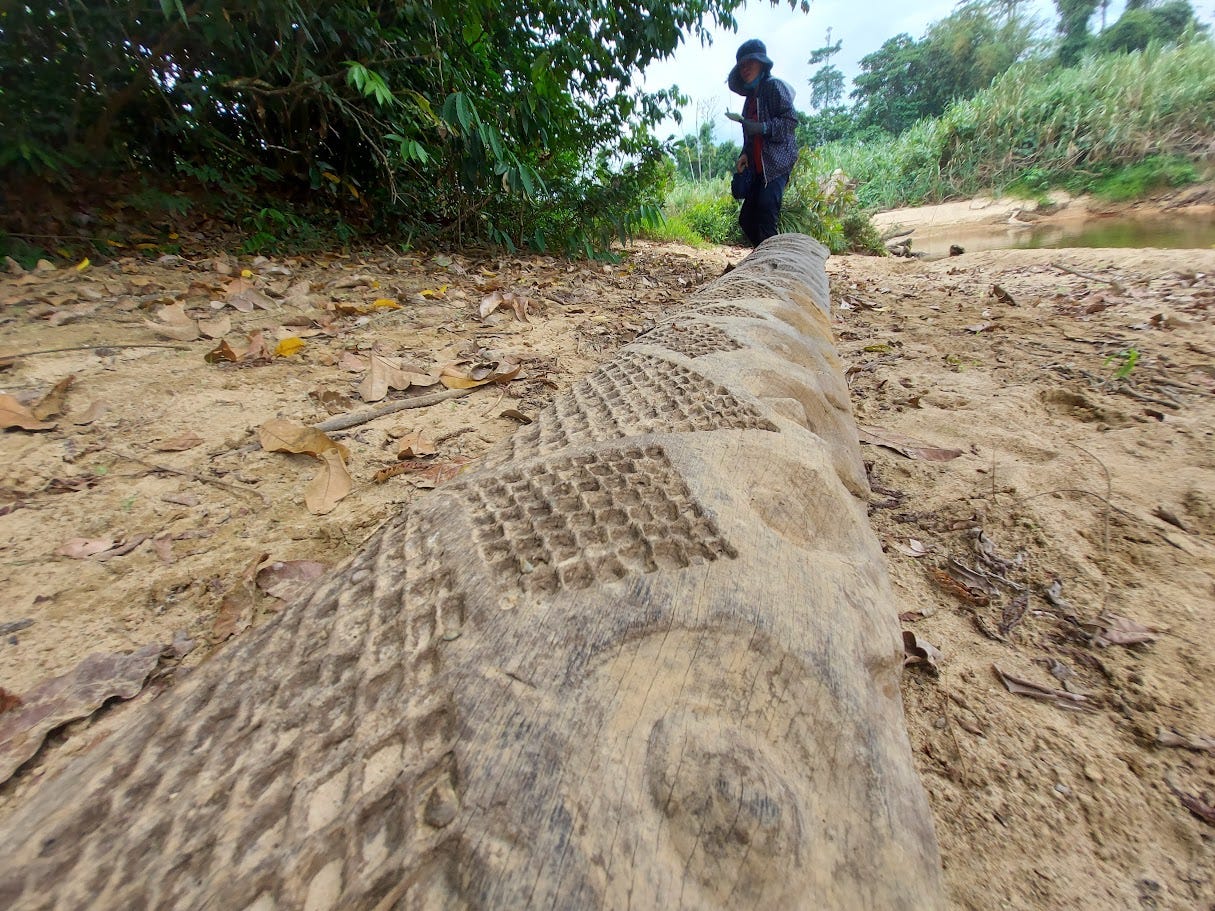
Associate Professor Dr Elena Chai examines what remains of the klirieng near Sungai Maskin, Pejarai, on October 16, 2021. The pole measures more than six meters. The carvings that survived four decades underwater are almost gone. The argument about who has the right to move it was just beginning.
If you have not seen a klirieng up close, the photographs do not prepare you. What looks in the distance like a fallen tree resolves, on approach, into something made by human hands at great deliberate effort. The carvings that remain after forty years underwater are geometric and precise, pressed into wood dense enough to survive a river. A researcher crouches beside the pole, her hand tracing what the current has left behind, the forest rising behind her, two men standing at the edges of the frame. The scale of the pole against the scale of the people makes the question of where it belongs feel less abstract. This is not a relic. It is an object whose makers are represented, in some unbroken line, by the living.
The project to relocate the klirieng was not malicious. That is the first thing worth saying, and the hardest, because it complicates the story in ways that make it true. Dr. Elena Chai, an anthropologist with a genuine investment in the material culture of Sarawak’s interior, had identified the submerged poles as an urgent conservation priority. Wood does not improve underwater. The carvings blur, the figures that mark the dead become unreadable, and the site deep in the interior is difficult to monitor or protect. From a conservationist’s perspective, the river was finishing what time had started, and intervention was overdue.
But conservation, like naming, is never innocent. To extract the klirieng from the Pejarai and relocate them to a district office, pending transfer to a permanent site to be determined later, is to make a decision about who holds authority over the dead. It is to say: these objects now belong to the category of heritage, which belongs to the state, which will consult the appropriate experts. The Bagatan community living along the Penyarai understood this without needing those words. Tr. Samun understood it standing up in front of a minister without knowing the name of the river he was defending. The klirieng were not objects. They were obligations.
Dr. Elena had done something else, something that would complicate her own project in ways she could not have foreseen. Believing that communities should speak in their own voices, she had encouraged each group in the region to write its own history. It was a generous instinct, born from years of watching outside authorities speak for people who had not been asked. The Punan wrote their history. The Bagatan wrote theirs.
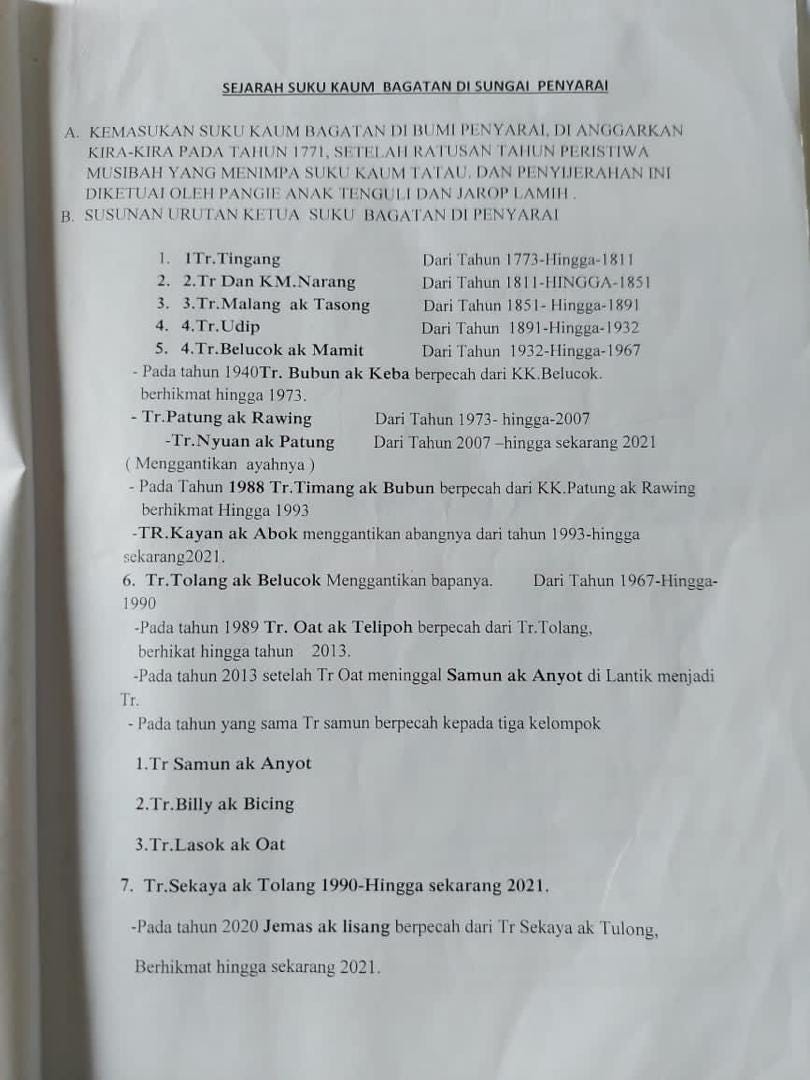
The Bagatan document is titled, in Malay, Sejarah Suku Kaum Bagatan di Sungai Penyarai — the History of the Bagatan People at Penyarai River. It is typed, formatted, careful in its presentation. It lists the community’s leaders in chronological sequence, assigns dates to each tenure, and traces the Bagatan’s arrival in Pejarai to approximately 1771, led by Pangie anak Tenguli and Jarop Lamih.
When Penghulu Sekaya ak Tolang handed me that document at his sibling’s house in Bintulu, he said nothing about the dates. He did not need to. He is a former schoolteacher. He knows what a date means and he knows how to read a document. Pangie and Jarop, the men named as founders in 1771, were alive in 1925. He knew this because he is descended from Malang, one of the three men who negotiated the Bagatan’s actual entry into Pejarai that year. Not in 1771. In 1925.
The real founding of the Bagatan community at Pejarai is a story of negotiation and tribute conducted within the social architecture of the Tatau basin in the early twentieth century. In 1925, Penghulu Sunyong, a Punan leader who held customary authority over the river, relented to a plea from Pangi, Jarop, and Malang to relocate into Pejarai. This was not a simple matter of three families moving upriver. It required permission, and permission in the Tatau basin carried a price. The Bagatan gave Penghulu Sunyong a lipen and several valuable items. In return, they received the right to settle.
That transaction is the founding moment of the Bagatan presence at Pejarai. It is also entirely absent from the document the sons wrote.
The gap between 1771 and 1925 is not a failure of memory. Oral traditions do not misplace events by a hundred and fifty-four years. What the sons did, whether consciously or through the particular alchemy by which communities reshape the past toward present need, was write over the negotiation. They erased Penghulu Sunyong. They erased the lipen. They erased the fact that their ancestors arrived as guests who paid tribute to a Punan tengelan for the right to be there. In doing so, they transformed a story of negotiated settlement into a story of primordial presence. A people who arrived in 1771 have a different relationship to a place than a people who arrived in 1925. One is origin. The other is migration. The sons understood the difference, even if they never said so.
Penghulu Sekaya knew all of this. He is Malang’s descendant. The founding negotiation lives in his lineage. He handed me the document without his signature on it. His name should have appeared at the bottom of the page, as the recognized community leader of the Bagatan in Tatau District. It did not. He could not put his name to something he knew was wrong. But he could not stop it either. Tr. Samun and the other Bagatan submitted the document to the government without the penghulu’s signature, and then, through Jaing Bubun, chairman of the Bagatan Penyarai Tatau Heritage Conservation Committee, they threatened to sue.
The formal objection letter that followed was drafted by a lawyer the community had hired, its language precise, its distribution list copied to five government bodies. The Bagatan had learned which register the state listens to.
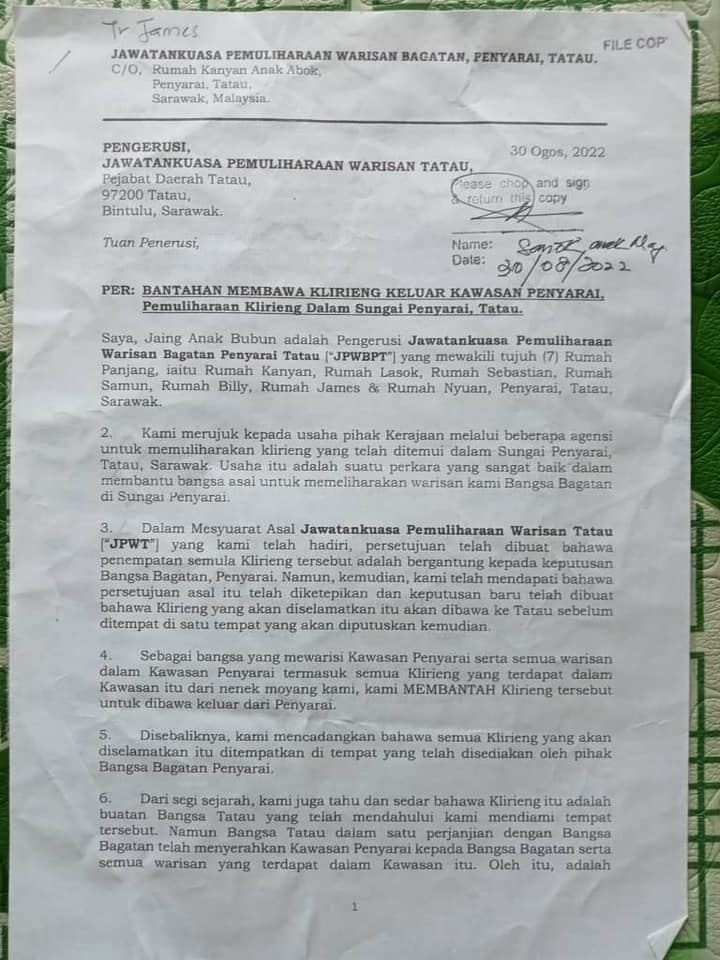
The formal objection letter from Jaing Anak Bubun, chairman of the Bagatan Penyarai Heritage Conservation Committee, dated 30 August 2022. It was drafted by a lawyer the community hired. Representing seven longhouses, Bubun acknowledges in paragraph six that the klirieng were made by the Tatau Punan who preceded them, then invokes the 1925 agreement as the legal basis for Bagatan custodianship. The community that paid tribute to enter Pejarai is citing that payment as title to everything within it.
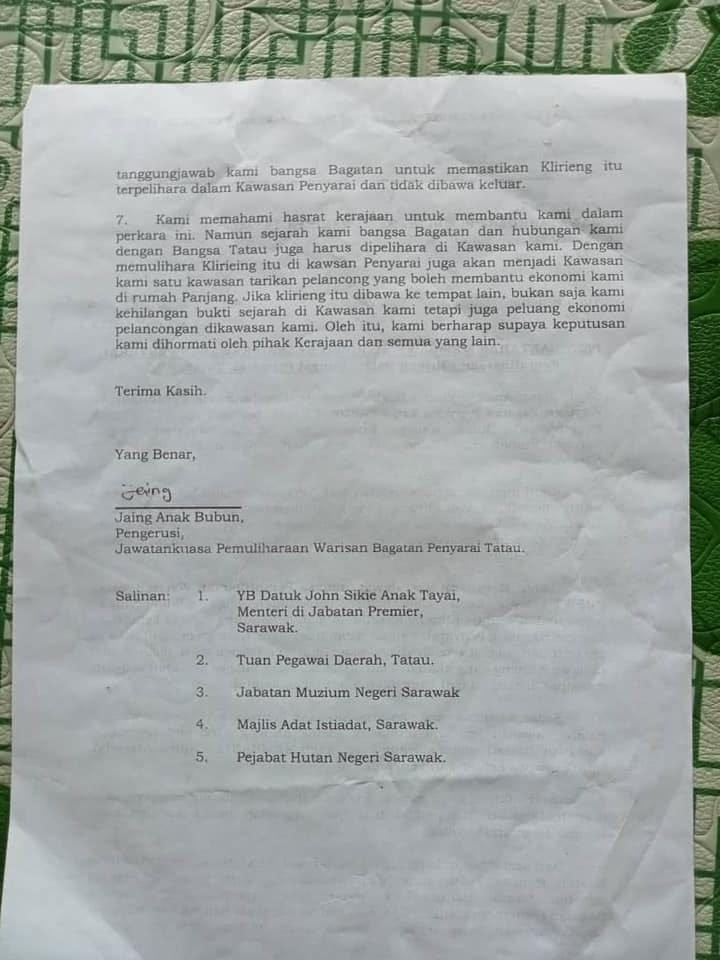
The closing page of Bubun’s letter, signed and distributed to five government bodies including Dato Sri John Sikie Tayai and the Sarawak Museum Department. The Bagatan did not protest informally. They filed. The document with the impossible dates and this letter arrived in the same government offices at the same time. Together, they were enough.
The protest at the Maskin site, when it came, was not a formal legal action. It was twenty-odd men standing in mud behind red-and-white tape, a handwritten sign nailed to a plywood board between two bamboo poles. The sign read: Kami Membantah “Klirieng” Kami Dipindahkan Ke Tempat Lain. Kami Komuniti Bagatan Penyarai Tetap Mempertahankan Hak Kami. We object to our klirieng being moved to another place. We, the Bagatan Penyarai community, will continue to defend our rights. The sign closed with Terima Kasih. Thank you. The courtesy at the bottom of a declaration of resistance is a distinctly Bornean register, and it is not incidental. It is the difference between a grievance and a position.
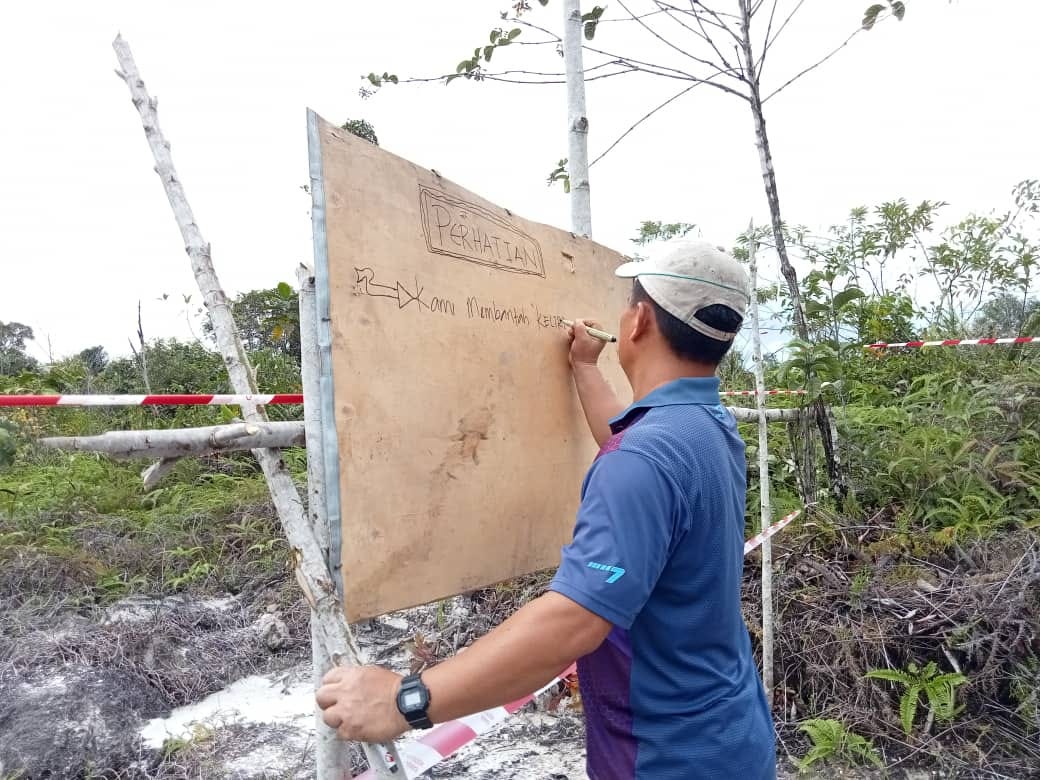
Jaing Bubun writes the protest notice at the Maskin site, September 2022. The first line is not yet finished. In the same week, the Bagatan submitted a community history placing their founders in 1771. Both documents — the typed one and the handwritten one — said the same thing: we are here, and you need our consent.
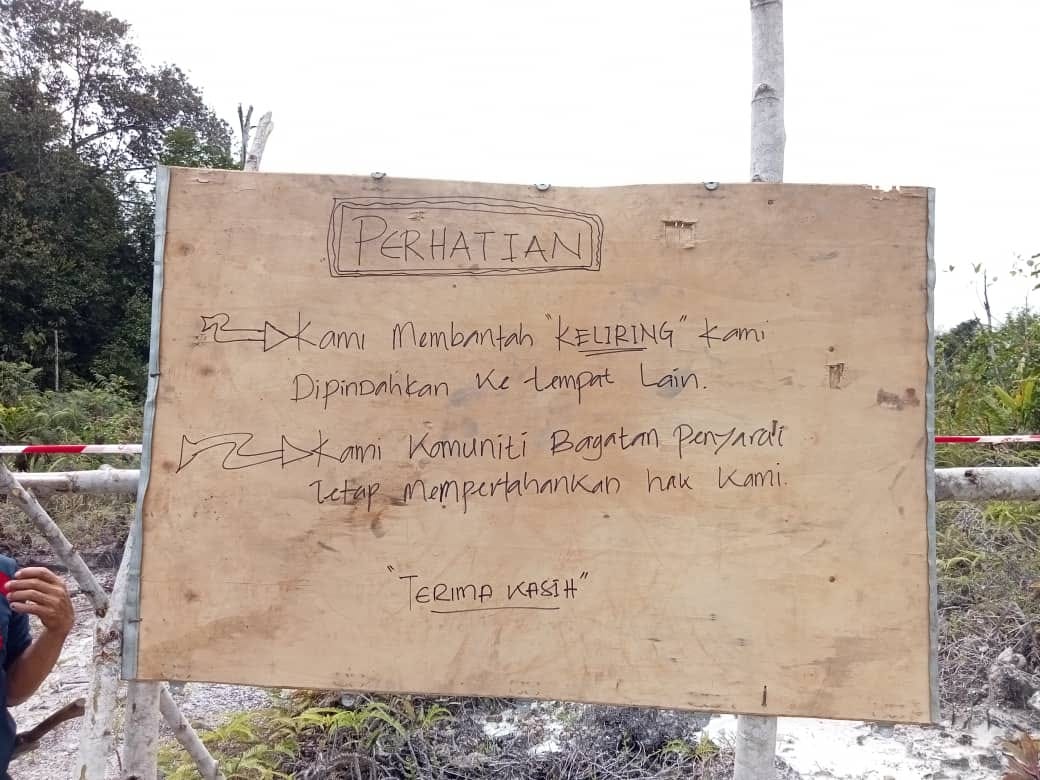
The finished notice reads: “We object to our klirieng being moved to another place. We, the Bagatan Penyarai community, will continue to defend our rights.” It closes with Terima Kasih — Thank you. The courtesy at the bottom of a declaration of resistance is not incidental. It is a position, not a grievance.
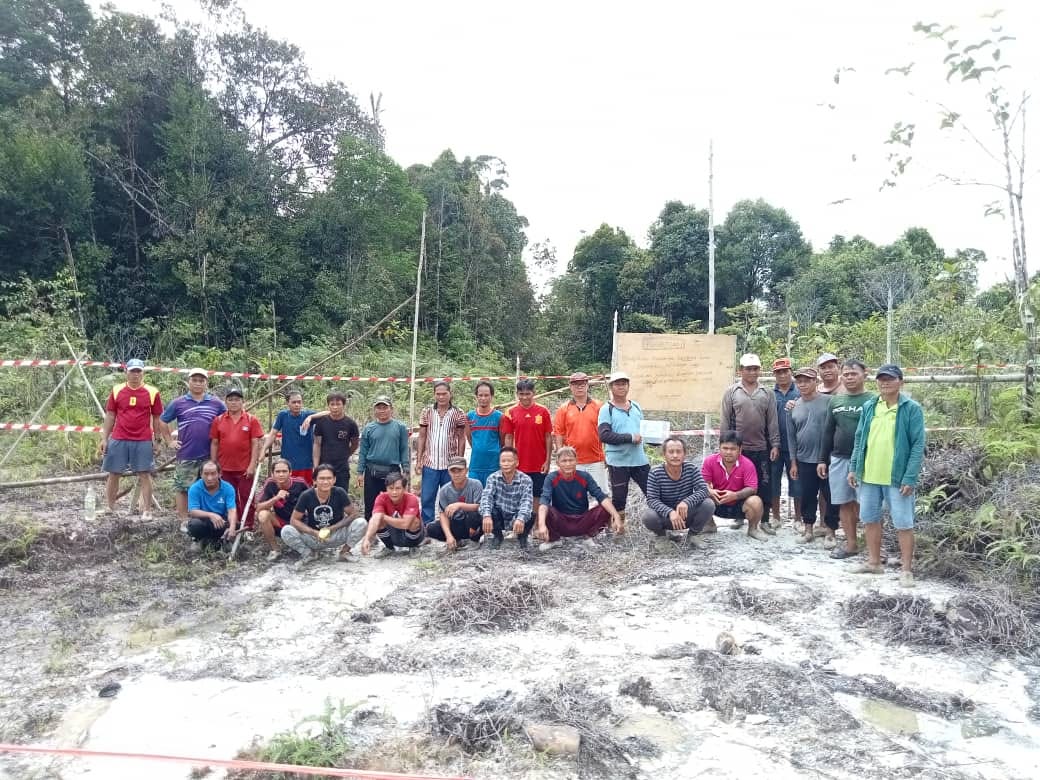
Members of the Bagatan Penyarai community stand behind the barricade at Sungai Maskin, September 2022. No lawyers present. No institution behind them. The protest stopped a government project backed by a minister, an anthropologist, and the Punan National Association. Twenty men in mud did that.
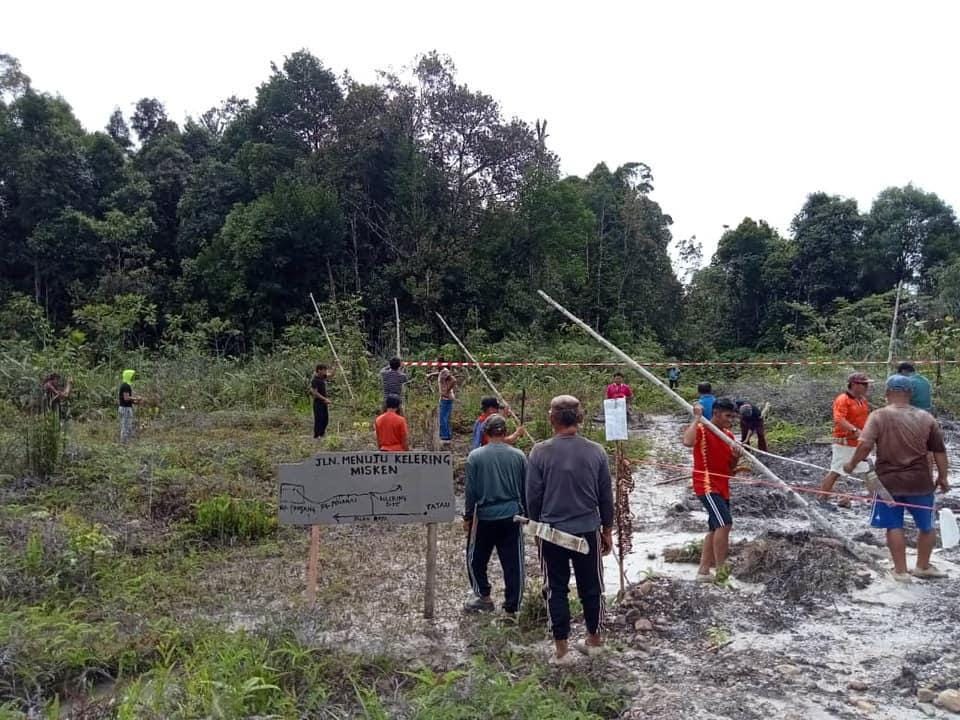
The barricade at Maskin takes shape. The materials are bamboo and red-and-white tape. The Sarawak Museum Department and the Sarawak Customs Council had equipment, legal authority, and scholarly backing. The Bagatan had this. It was enough.
One photograph shows the sign being written, a man pressing a marker to the plywood, the first line only half finished. The resistance had not yet become legible. He was making it so. That moment — the instant a community’s refusal crossed from spoken to written, from presence to document — is the same crossing the sons of Tr. Samun had made when they typed out the history with the impossible dates. The Bagatan had learned, in the space of a single generation, that the state responds to writing. So they wrote.
The government, unwilling to be seen coercing a minority community over burial poles, shelved the project. The Sarawak Museum Department and the Sarawak Customs Council stood down. Dr. Elena Chai’s conservation effort, years in the making, stopped not because of a court order or a scholarly counter-argument but because of a handwritten sign, a threatened lawsuit, and a formally filed objection letter that cited an agreement the community’s own history document had erased.
What followed was a public dispute between communities. A joint statement signed by Punan leaders, including Penghulu Sanok Magai, Penghulu Nicholas Mering Kulleh, and the Punan National Association, expressed disappointment with the protest group and affirmed that the klirieng belonged to the Punan people of Tatau. The statement noted that Jaing Bubun himself had acknowledged in media reports that the artifact was not Bagatan heritage. Previous Beketan village chiefs had said the same in 1978, and again to a team of researchers from MAIS and Universiti Malaysia Sarawak in 2000. The Bagatan’s own representatives had repeatedly, across decades, confirmed that the poles belonged to someone else. And then they stopped those people from moving them.
This is not hypocrisy. It is a precise understanding of how leverage works. The klirieng were Punan heritage in origin and Bagatan geography in fact. The poles lay in Bagatan-claimed territory, connected to a site the Bagatan had occupied since 1925, when Penghulu Sunyong gave them permission to be there. To allow the state to remove the klirieng in the name of Punan heritage was to concede that the land’s deepest history belonged to someone else, and that the state had the authority to act on that history without Bagatan consent. Tr. Samun understood this without a document. His sons wrote it down anyway. Their lawyer put it in formal Malay and copied it to a minister.
There is something almost architectural about how this unfolded. Dr. Elena asked communities to write their own histories, believing this would restore indigenous voices to a record that had long been written by outsiders. The Bagatan wrote one. The history they produced served their immediate purpose with precision, establishing deep-time presence, conferring standing, making the klirieng theirs in a way that a government project could not easily override. And the woman whose instruction created the document found herself on the other side of it.
This is not a story about deception. It is a story about what happens when two different understandings of how the past works encounter each other across a river. Dr. Elena’s understanding says that objects have conservation value that outlasts any single community’s claim, and that trained professionals are the appropriate custodians of that value. The Bagatan’s understanding says that the dead belong to the living who inhabit the same ground, and that presence, physical and historical and genealogical, is not something you relocate to a facility pending a determination of permanent placement. Both positions are coherent. Neither is simply right.
What Tr. Samun understood, rising in front of a minister without the name of the river on his tongue, is that in the room where decisions get made, presence is the only argument that cannot be countered by a better-sourced rebuttal. Not accuracy. Not dates. Not the signature of a former schoolteacher who knows too much to sign. Presence. The willingness to stand and say: this is ours.
Penghulu Sekaya sits with a different weight. He carries the actual story, the 1925 negotiation, the lipen, Penghulu Sunyong’s permission, his own ancestor Malang standing at the mouth of a river and paying for the right to call it home. He knows what the document erases. He knows the klirieng are bound to a Punan tengelan’s world, not to any Bagatan founding. He watched the document work. He watched the lawyer’s letter work. He watched twenty men in mud work.
I have thought about this often since that afternoon in Bintulu, sitting with the typed pages in my hands while Penghulu Sekaya said nothing about his missing signature. The historian in me wants to restore what was written over: Pangi and Jarop in 1925, not 1771; Penghulu Sunyong at the mouth of the river; the lipen whose name no document records and whose descendants are not part of this story because no one thought to include them. The dates matter. The erasure matters. The lipen, unnamed in every account including this one, matters most of all.
But the klirieng are still in the river. And the Bagatan are still on the banks of the Pejarai, the descendants of men who paid for the right to be exactly where they are. The document that should not exist, with its impossible dates and its absent signature, kept them there.
Sometimes a wrong document does the right thing. The scholar who knows the difference has to decide what to do with that knowledge. Penghulu Sekaya made his choice. He handed me the paper and said nothing about his name at the bottom of the page where it should have been.
I am still deciding.